Flight Review if Fly a Twin Can Do It in a Single

It's only human nature. There you are, looking through the Bonanza or Cessna 210 or Mooneyads in Trade-A-Plane to cheque out how much your retractable single has appreciated-or peradventure to find out what it would cost to merchandise upwardly from your fixed-gear bird. Suddenly,without alarm, your optics are drawn downward the page by a mysterious strength field and arecaptured by the Aerostar or Baron or Cessna 310 section.
Y'all scan through some of the twin ads and it suddenly dawns on you: hey, these twinsare selling for a lot less than I would have guessed. In fact, for the cost of a cleanearly-80s-vintage A36 or 210, you lot can buy a nice mid-time tardily-70s Cessna 310 or even anearly-70s pressurized cabin-class Cessna 340. And yous get to thinking "Gee, I couldbe flight a twin!"
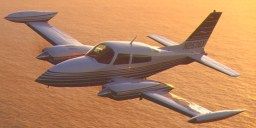 That's exactly what happened to me in 1987. I was in the market to buy a nice late-modelT210 and looking through T-A-P when my eyes strayed south. Before I returned to mysenses, I found myself the owner of a 1979 Cessna T310R. And I've spent the last nineyears learning almost the pros and cons of twin buying.
These days, I observe myself talking to lots of pilots asking for advice about buyingtheir commencement twin Cessna. And I counsel most of them to call up very carefully before takingthe leap into twin ownership.
Don't get me wrong. My T310R has been a wonderful aircraft. It has been very reliable,a not bad traveling machine, and has treated me very well indeed. It also has appreciatednicely since I bought information technology. But I've learned a lot about twin ownership since then, and ithasn't all turned out exactly equally I anticipated. Bluntly, if I were shopping for anaircraft today, I'chiliad non sure information technology would be a twin.
Bigger and Faster?
One affair I learned pretty quickly is that if you want to go fast, adding a secondengine is not a good style to do information technology.
My friend John Frank is executive director of the Cessna Pilots Clan. John and Itravel together quite often to teach seminars in various parts of the U.Due south. Sometimes wetake John's T210 and sometimes we have my T310R. There's no observable difference intravel time.
According to volume figures, my twin is about 10 knots faster than John's single. But Irecall the time a few years ago that John and I flew both of our airplanes from Cincinnatito Wichita, a trip of about 650 NM and iii.5 hours. John took off from Cinti merely a coupleof minutes before me, but I didn't take hold of him until we were about x minutes from touchdownat Wichita.
The big difference revealed itself when nosotros both refueled at Wichita. John'due south fuel tabwas almost $120; mine was over $200.
The 310 looks similar a much bigger shipping than the 210. Max gross is about two,000 poundsmore: 5,500 versus 3,500 pounds. Simply this tin be deceiving. Useful load is simply 400 lbs.more than-1,600 versus 1,200 pounds-and on long legs that difference is fully consumed past theadditional fuel the twin needs to carry.
The 310'south motel is considerably more spacious than the 210'due south, about viii inches wider, andoffers capacious space for baggage in its wing lockers and its huge 21 cubic foot nosebaggage compartment. But on long trips (the kind I fly a lot) at that place's hardly any practicaldifference in load carrying ability or speed.
The aforementioned holds true for most light twins: Aero Commanders, Aerostars, Aztecs, Barons,and Cessna 320s, 340s, and 414s. If you desire to booty appreciably more than load than a Cessna210 tin can carry for whatever meaning distance, y'all'd need to look at a large heavy twin likethe Cessna 402 or 421 or Piper Navajo.
It is non far from the truth to say that the master office of a lite twin'due south secondengine is to overcome its own elevate and to deport its own weight and the weight of theadditional fuel information technology requires!
Are Twins Safer?
The question of whether twins are actually any safer than singles is guaranteed totrigger a vigorous debate in any grouping of pilots. I recently finished editing a Cessna 310safety review for the AOPA Air Safety Foundation. In the course of this project, I took anin-depth look at the safety record of the Cessna 310 and a group of comparable aircraft(Aerostar, Aztec, Baron, Commander, Crusader) during the eleven year period from 1982through 1992. Some interesting statistics emerged from this report.
The overall accident rates of high-operation singles (like Bonanzas or 210s orMooneys) and light twins (like Aerostars or Barons or Commanders or Cessna 310s) areastonishingly close. Twins have a slightly college accident charge per unit per 100 aircraft and aslightly lower accident rate per 100,000 hours, only for all practical purposes theaccident rates are the same. The same is true if you lot consider merely "serious"accidents that involve death, serious injury, or substantial damage. For bothhigh-functioning singles and calorie-free twins, approximately one-tertiary of all accidents areclassified as serious.
For both singles and twins, roughly three-quarters of all accidents are classified every bit"airplane pilot caused". While atmospheric condition-related accidents dwarf all other pilot causes inthe unmarried-engine accident data, the pattern for twins seems to be significantlydifferent. Weather is still the leading cause of pilot-acquired twin accidents, simply avariety of other non-weather-related causes are quite pregnant: botched takeoffs andlandings, controlled flight into terrain, improper IFR procedures, fuel burnout, andgear-upward landings, only to name a few.
About one-fourth of all accidents are classified as "auto caused" for bothsingles and twins. Only a small fraction of those are engine-failure accidents. But information technology'sinteresting to await at the impact of that second engine on engine-failure accidentstatistics.
For the group of lite twins we looked at, mechanical failures of the engine orpropeller were responsible for One about iii% of all accidents. Breaking that down, 15.3% ofall accidents were due to mechanical failures, and twenty.8% of those involved the engine orpropeller.
In contrast, roughly 8% of all accidents in high-performance singles were attributed toengine or propeller failure: 17% of accidents were mechanicals, but virtually 50% of thoseinvolved the engine or prop.
The statistics showed that a light twin is most equally probable to have amechanical-caused accident equally a loftier-performance single. But the twin's mechanical problemis most likely to be gear-related while the unmarried's is most likely to beengine/prop-related. A single is about 2-and-a-half times more likely to have anaccident due to engine/prop failure than a twin (viii% versus three%). And if we assume that atwin is twice every bit likely to have an engine/prop failure (since it has twice as many tofail), and so nosotros tin conclude that an engine/prop failure in a single is five times morelikely to consequence in an blow than an engine/prop failure in a twin.
And then are you any safer flying a lite twin than a loftier-performance single? In terms ofthe overall and serious blow rates, the answer seems clearly to be no. Only your riskprofile changes somewhat: in the twin, you're less likely to be hurt by an engine failure,and more likely to be victimized past something else.
Operating Costs
If you have to ask, don't even consider ownership a twin.
Seriously, an in-depth assay of operating costs is beyond the telescopic of this article.But we can have a quick wait at this distasteful subject.
There'south an old rule-of-thumb that says yous can get a rough approximation of the hourlyoperating price of flying an aeroplane 200 hours a year by taking the hourly price of fueland multiplying past four. Using this rule and assuming that avgas costs $two.00/gallon andthat the fuel burns for the Cessna 182, 210 and 310 are 13, 16 and 30 gallons/hour,respectively, we come up with operating costs of $104, $128, and $240 per hr.
And in fact, these figures aren't far from what a more rigorouscost assay yields. Note, yet, that operating cost calculations have a lot ofvariables, and your costs may differ essentially from the figures shown here. Forexample, our figures ignore depreciation (or appreciation) and opportunity cost of funds.
Maintenance
I give mixed reviews to maintenance on the twin Cessnas.
My personal experience with my 1979 Cessna T310R has been exemplary. After the firsttwo "catch-up" annuals (which cost about $7000 each), I've found maintenance onmy airplane to exist surprisingly economic. But mine is probably an unusual instance: I waslucky enough to purchase an extraordinarily make clean and well-maintained 310, and I've done nearlyall the maintenance piece of work on it myself.
When I started swinging wrenches on my 310, I constitute (to my surprise and please) thatthe most twins are very easy to work on-often a good deal easier than loftier-performancesingles. The twins are big, roomy airplanes and maintenance access is generallyoutstanding. This is particularly truthful of the engine compartments, which are incrediblyspacious compared to, say, a M252 or T210 or B36TC.
On the other side of the coin, I've seen many cases (including some good friends) offolks who moved up from a high-performance unmarried to a lite twin and were inundated withruinously expensive maintenance problems which, in several cases, finally forced them tosell the aircraft.
The best defense confronting costly maintenance surprises is meticulous attention topreventive maintenance. This is truthful of whatever aircraft, just especially and then of twins where thesurprises tin can be very expensive indeed. Frequent cleaning of the exhaust trails and flapwells can forestall wing spar corrosion. Careful inspection of exhaust components at everyoil change can foreclose severe oestrus damage to the engine mount keels. Performing a fulllanding gear rigging without fail at every annual is the best defense force against landing gearcollapse and peachy of the fly adhere structure. Neglect any of these preventive stepsand sooner or later yous're likely to be in for a nasty shock.
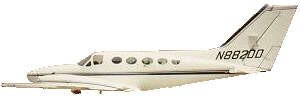 Some of twin parts are hideously expensive. I had to replace my windshield hot-plate someyears ago and was floored to discover that a replacement price $v,000. Last time I looked,the cost was up to $8,000. But that's cypher compared to a heated drinking glass half-windshieldfor the Cessna 414 or 421, which cost $25,000 last time I looked!
And information technology'due south not just windshields that are pricey. Replacement landing gear parts liketorque tubes, pushrods and uplock hooks too cost x times what you'd expect.
In general, parts prices are well-nigh reasonable for parts that plough over rapidly, andunreasonable for parts that don't motion. (That'due south reverse of the way my professor taught methat supply and demand is supposed to work, but then he wasn't involved in aviation.)These pricey parts are the ones that don't require replacement very often-just when theydo, buss your checkbook goodbye!
The thing to remember is this: although you lot may have purchased your"pre-endemic" twin for $100,000 or $200,000 (or perhaps a good deal less if information technology wasan older model), that airplane would sell for $1 million or more than if Cessna or Piper orAero Commander were building it today. And as far equally the toll of parts and maintenance isconcerned, y'all ain a million-dollar airplane. When a manufacturer sets its parts prices,y'all can be sure it doesn't pay any attending to what the airplanes are going for inTrade-A-Aeroplane.
Reliability
In theory, a complex machine like my known-ice-equipped, turbocharged, twin-engineT310R should take a lot more than bug than a simpler aircraft like a Cessna 182 (my firstairplane). The twin has so many circuitous systems…and so many more than things to go wrong. When Iopen upwardly my aircraft at the annual and wait at information technology with all its guts exposed, I'm sometimesamazed that so circuitous a auto works at all.
In do, my experience has been the opposite. My 310 has proven itself to be themost reliable airplane I've ever owned. Everything works almost all necktie time, andunscheduled maintenance has been almost nil. Just many twin owners don't share my goodfortune, and some of the twins are existent hangar queens.
The secret to reliability is uncompromising attention to preventive maintenance. Be ona constant lookout for the commencement signs of corrosion, chafing, leakage of fuel, oil orexhaust, changes in engine musical instrument readings, or anything that looks, feels, or soundsunusual. If you notice a pocket-size leak or chafing problem at an oil change, set information technology at present-don'tput it off until the next annual.
If y'all need a reliable aircraft but aren't prepared to become compulsive aboutpreventive maintenance, you'd exist a lot better off owning a simpler aeroplane.
Weather Flight
Flying in rotten weather is the fourth dimension I'g most happy to be a twin owner. That actress tonof gross weight and "big airplane feel" inspires a lot of confidence when flyingin turbulence. The boots, hot props, and other known-ice gear helps me go on my cool whendealing with icing conditions. And having 2 engines is reassuring when flight over wateror inhospitable terrain, especially at dark or in IMC.
Although the second engine doesn't do much for speed, it definitely offers a big boostin the climb department. In cruise, the ability from the spare engine is largely consumed inovercoming the twin's extra drag. But parasite elevate varies with the square of airspeed, soat slower airspeeds (takeoff and climb) a twin has a big reward in terms of excesspower available. This means that a twin often has the climb capability to escape adowndraft or get above an icing layer when a single might not manage very well.
When I offset bought my T310R, I was really excited near having all that deicingequipment. Only afterward flying information technology in all sorts of weather for nearly a decade, I've foundthat the utility of the deicing gear is greatly overrated. Information technology isn't that the boots and hotprops don't work-they practice-but that they are so seldom needed when flying a turbochargedaircraft. Turbocharging gives you such a wide choice of altitudes between the MEA and theservice ceiling that there'due south near always an water ice-complimentary distance to be institute. I'd guessI've actually accumulated plenty ice to utilize the boots perhaps a one-half-dozen times since Ibought the aircraft-and in none of those cases did I consider having the boots to be adecisive advantage (in virtually cases I was descending through an icing layer into warmer airthat would have melted the ice off anyway).
If you fly a lot of thunderstorms, weather radar is nice-and twins provide the radomearea and panel space for a offset-class radar installation. You can put radar in a unmarried,too, simply the small pod-mounted antenna reduces its range and resolution sharply. My 310has no radar, only a Stormscope, but then far it has done a dandy job of keeping me out oftrouble.
Rails Requirements
One of the downsides of flying a conventional twin (other than cost) is poor short- andsoft-field operation. My 310 is heavy (5500 pounds), lands fast (92 knotsover-the-fence), and has barely-adequate brake chapters.
For the first several years later I bought the 310, I avoided any drome with lessthan 4,000 feet of difficult-surfaced runway, and I'd propose other new twin pilots to exercise thesame. The trouble isn't landing-it'due south takeoff. On takeoff, 4,000 anxiety is barely long enoughto let a 310 to accelerate to minimum safety single-engine speed, lose an engine, andpanic-stop without running off the end of the runway. With whatever less runway, losing anengine near rotation speed leaves you with no good options: non enough speed to fly on oneengine, and not enough rail to cease.
Even at present that I've been flight the 310 for near ten years, I'm extremely reluctant touse an aerodrome shorter than 3,000 anxiety. Once in awhile, I'll operated out of an drome asshort as 2,500 feet, only only at extremely light weight (one person, minimum fuel). Eventhen, I am acutely enlightened that I'1000 taking a calculated run a risk-betting my life that an enginewon't fail during the takeoff scroll-and I don't like that feeling one bit.
When flying singles, I always felt comfortable landing at dirt strips and fifty-fifty on dirtroads, particularly in Mexico. In the 310, I feel pretty much limited to tarmac. Theairplane is too heavy and the landing gear likewise frail for me to operate comfortably on anunpaved rail. Fifty-fifty parking on the grass (as at Oshkosh) makes me worry about sinking inand getting stuck.
Recurrent Training
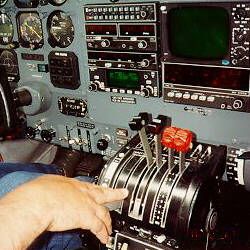 Information technology's not easy to achieve and maintain proficiency in a piston twin. Engine-out emergenciesare difficult to practice realistically in the plane without jeopardizing safety, andengine cuts tin be very tough on the engines, particularly in turbocharged models.
For this reason, I strongly recommend simulator-based initial and recurrent trainingfor twin Cessna pilots. Excellent piston twin simulators are available at FlightSafetyInternational Simcom.
But this sort of training doesn't come cheap. My annual training contract atFlightSafety costs $4,200 a year (and goes up every year or two). Simcom is a little lessexpensive, but yet quite steep.
I'm convinced that frequent simulator training is an essential prerequisite to operatea twin safely. If you have trouble justifying the expense, you'd probably be better offnot flying a conventional twin.
Insurance
When y'all first movement upwardly to a twin, you'll probably find information technology difficult to get insurance.No thing how many ratings or accident-free hours you lot have, underwriters are reluctant toinsure y'all in a twin until you have at least 500 hours total time and l hours in blazon,and tend to charge painfully stiff premiums until y'all have a few hundred hours in blazon.
The accident statistics explain why. Pilots with less than i,000 hours total flighttime or 100 hours in blazon are far more likely to have a serious blow than pilots withmore experience.
So in addition to budgeting extra cash for an expensive catch-up annual during yourfirst yr of twin ownership, plan on setting bated extra coin for extra steep start-yearinsurance premiums.
A recurrent grooming contract with FlightSafety or Simcom is usually very helpful insecuring a lower insurance premium. Underwriters dearest pilots who undergo regular simulatortraining. Some even require such training before they'll insure y'all.
If You lot Decide To Take The Plunge
Despite the fact that a lite twin is expensive to operate and maintain, difficult toinsure, not peculiarly fast or peculiarly good at hauling large loads, and notdemonstrably safer than a loftier-operation unmarried, you lot might turn out to be 1 of thosestubborn folks who decide to purchase one anyhow. If y'all do, be very conscientious most whichairplane you buy. If you air current up with a lemon, it's probable to be one of the most painfulmistakes in your aviation career.
Do yourself a favor by looking at lots of airplanes before you make up one's mind to buy one. Trynot to be influenced by cosmetics like paint and interior-it'southward what's under thefloorboards and inside the nacelles that really matters.
Purchase the cleanest, latest-model plane you lot can possibly beget. Early 310s and Aztecsand Travel Arrogance tin be purchased for a song, but may easily plow out to exist a disastrousmoney pit.
Don't hesitate to buy a twin with high-fourth dimension engines, assuming the price is correct. Ifyou buy a runout airplane and overhaul the engines yourself (or replace them with factoryremans), you lot'll know exactly what you lot've got. Beware of buying a twin with low-timeengines unless they are factory remans or were overhauled past a superlative-notch shop likeMattituck or RAM. If the seller overhauled the engines with the intention of selling theairplane, the overhaul might well exist questionable.
Before y'all plunk your money downwards to buy a twin, talk to your insurance agent and makesure you can get it insured. Find a adept A&P/IA with lots of experience on yourparticular model and accept him go over the airplane with a fine-molar rummage. Programme onspending $i,000 or so on the pre-purchase-it'll pay for itself many times over. Anddespite that thorough pre-purchase inspection, be prepared to spend a bundle-$ten,000 orso-on the outset couple of annual inspections to get the airplane totally upwardly to snuff.
Do all that and yous can await years of rewarding twin ownership, with a minimum ofunpleasant surprises.
The Skymaster: A Unlike Twin
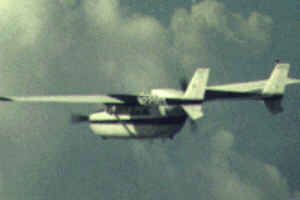 Adiscussion of twin ownership wouldn't be complete without mentioning Cessna'sunconventional twin, the Model 337 Skymaster. Much of what we've said about thewing-mounted twins applies to the Skymaster, too. It'due south not specially fast or roomy,can't carry a great bargain of payload, and is costly to operate and maintain.
In fact, the Skymaster is i of the most maintenance-intensive airplanes that Cessnabuilt. It combines one of Continental'southward near problem-decumbent engines (the IO-360), a complexlanding gear system (from the early 210), a poorly-designed electric system, and someoddball systems like motorized cowl flaps. Different near wing-mounted twins, the Skymasteris not piece of cake to piece of work on, and its engine compartments are particularly tightly packed.
Just the Skymaster is an accented please to wing, and does things that no other twin cando. Information technology'due south a superb curt- and crude-field airplane. Information technology has no Vmc problems, and then is idealfor pilots who don't fly a lot and can't justify the costly recurrent grooming demanded bya conventional twin. And it has the best engine-out performance of whatsoever piston-poweredlight twin.
If you're looking for twin-engine redundancy but put off by some of the disadvantagesof conventional twins, the Skymaster is definitely worthy of consideration.
|
Source: https://www.avweb.com/ownership/do-you-really-want-a-twin/

Post a Comment for "Flight Review if Fly a Twin Can Do It in a Single"